The custom apparel industry is booming thanks to the growing demand for personalized clothing and unique designs. This has led to the emergence of many different printing technologies, each with its own advantages and disadvantages. Of these, DTG (Direct-to-Garment) printing and Screen Printing are the two most popular methods. If you are in this business, understanding the differences between them will help you make the right choice for your goals.
1. Why Choosing a Printing Method is Important?
The printing method directly affects your production costs, product quality, and work efficiency. Factors such as order quantity, design complexity, production time, and operating costs all need to be considered. This article will give you an overview and detailed comparison between the two most popular printing methods.
2. Screen Printing
2.1 Definition and Process
Screen printing is a traditional printing method that uses a silk screen to transfer ink onto fabric. Each color in the design requires a separate screen, so the process is quite complicated.
Steps:
- Create the design: The design is prepared as a positive film.
- Prepare the screen: The screen is stretched over a frame and coated with a light-sensitive emulsion.
- Exposure: The design is placed under the screen and exposed to UV light to create the screen.
- Screen washing: The parts not exposed to light are washed away, forming the printing screen.
- Printing: Ink is poured onto the screen and a squeegee is used to force it through the open part of the screen, creating the image on the fabric.
2.2 Types of Inks and Equipment Used
Screen printing usually uses two popular types of inks: plastisol ink (high durability) and water-based ink (softer, more environmentally friendly). Equipment includes manual or automatic printers, exposure tables, mold washing tanks and drying systems.
2.3 Advantages & Disadvantages
Advantages:
– Cost savings for large orders.
– Bold, vibrant colors.
High durability, withstands many washes.
Disadvantages:
– Time-consuming preparation, especially for multi-color designs.
Not suitable for designs with high detail.
High cost when printing small quantities.
3. DTG (Direct-to-Garment) Printing
3.1 Definition and Process
DTG printing is a modern printing method that uses inkjet printers to print directly onto fabrics, allowing the creation of complex designs with many colors.
Steps:
- Design preparation: The design is digitized and transferred to the printer.
- T-shirt positioning: The shirt is placed on the printer’s printing table.
- Pre-treatment: A layer of treatment solution is applied to the fabric to help the ink adhere better.
- Printing: The printer sprays ink directly onto the shirt according to the design.
- Post-treatment: The product is dried to fix the ink.
3.2 Equipment and Ink Used
The DTG printer is an industrial inkjet printer, using environmentally friendly water-based pigment ink, for vivid colors and a soft feel.
3.3 Advantages & Disadvantages
Advantages:
– Print complex designs, sharp images.
– No minimum quantity required, suitable for small orders.
– Smooth color transitions.
Disadvantages:
– Printing speed is slower than screen printing when printing in large quantities.
– Higher ink costs.
– Need to be processed before and after printing, increasing production time.
4. Compare Print Quality
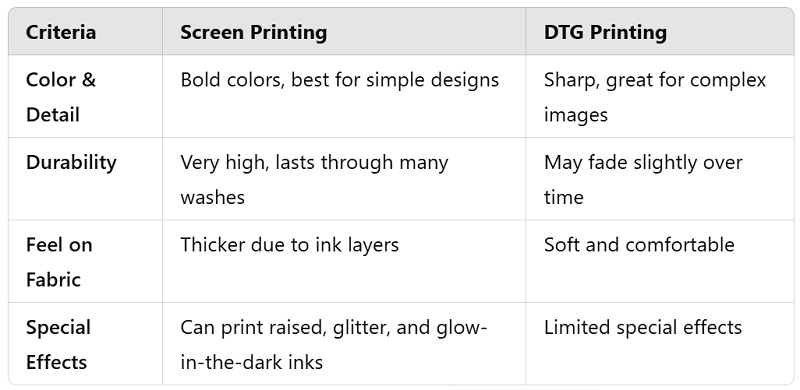
Print Quality Comparison
5. Cost & Business Efficiency
5.1 Initial Investment Cost
DTG Printing: Basic printers cost from $10,000.
Silk Screen Printing: Setting up a silk screen printing system is usually over $30,000.
5.2 Operating Costs
DTG Printing: Higher ink costs but less setup effort.
Screen Printing: Cheaper for large orders but time-consuming to set up.
6. Choosing the Right One for Your Business
1. When should you choose screen printing?
– When you need to print large quantities with simple designs.
– When you want to reduce the cost per unit.
– When you need high durability.
2. When should you choose DTG printing?
– When you print small orders, no minimum quantity required.
– When you need to print detailed images, complex colors.
– When you want to provide on-demand printing services.
Conclusion
Each method has its own advantages. If you are selling large quantities of t-shirts with simple designs, screen printing is a reasonable choice. If you are aiming for the personalized t-shirt market, complex designs, DTG printing will be the optimal solution. Hope this article helps you make the right decision for your business!.